
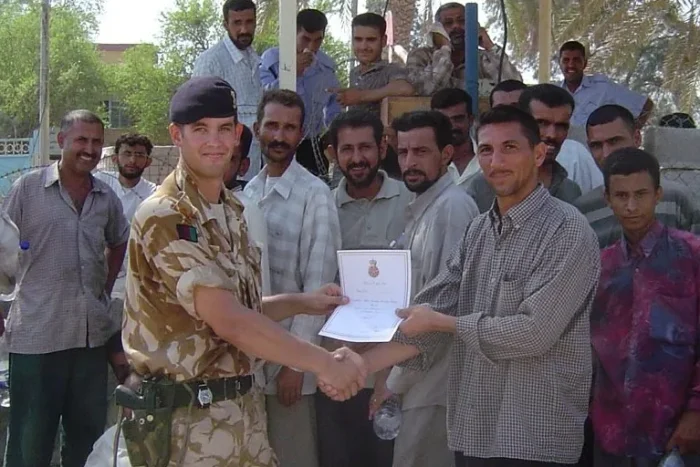
I was having a bit of a clear out recently when I stumbled across a report I’d written in Basra in late 2003. At the time I was 27, a young British Army captain, and I was just completing a tour that had seen me responsible for helping to coordinate the restoration of infrastructure and essential services across a city of more than a million people.
It was a good find, and I found myself sitting down and reading the whole thing, sometimes smiling, sometimes wincing, and often wondering how the twenty seven year old version of me could possibly have been so certain about everything.
Right at the top of the first page was an adaptation of a quote from T. E. Lawrence that had stuck with me since Sandhurst.
“Better let them do a poor solution than you presenting the best. For theirs is the land and the future and your time is short.”
Reading the report back, that principle ran through almost everything we were trying to achieve during that tour. We weren’t there to run Basra. We were there to help local people, local ministries and local institutions get back on their feet and, wherever possible, solve their own problems. Sometimes that meant standing back and watching people do something differently to how you would have done it. Sometimes it meant watching them do it less well than you might have been able to do it yourself. Neither was particularly comfortable.
I recall a specific example involving a UN agency operating in southern Iraq. Soon after the war phase of the operation ended in late April, it identified a severe shortage of clean drinking water in Basra, and its response was to source a fleet of tankers and invest significant time, effort and money bringing water in from outside Iraq.
What its leadership had not appreciated was that, before the war, much of Basra’s clean water had been supplied by small potable water producers across the city. These were enterprising local businesses that needed little more than a functioning water supply and electricity to provide what the city required in a sustainable and effective way.
The tankers were welcome at first. But once water and electricity began to flow again, the free imported supply crushed demand for the local producers. Had we not pointed this out, and had the free supply continued, most of those businesses would eventually have disappeared, leaving the city dependent on external aid rather than restoring a system that had worked perfectly well before.
What I hadn’t appreciated at 27 wasn’t the principle itself. We’d understood it perfectly well in Basra. What I didn’t yet understand was just how universal it was. I simply didn’t have enough experience to recognise it turning up almost everywhere else.
During the almost quarter of a century since (ouch) I’ve seen exactly the same principle crop up everywhere. In recruitment, in boardrooms, in growing businesses, in professional football, in raising two daughters, in fact in almost every leadership role I’ve ever had. The context changes, but human nature doesn’t.
One of the easiest traps for any leader is to confuse being useful with being indispensable. Solving problems feels productive, it feels like leadership, and it makes you feel good about yourself every time somebody says, “Thanks, I couldn’t have done that without you.”
The problem is that teams and organisations built around indispensable people don’t scale very well at all, they certainly don’t become more valuable, and worst of all, they stifle the initiative and growth of the people within them. Every big decision, every difficult conversation and every important relationship ends up flowing through one person, and that person usually can’t work out why they have become so busy.
Founders and business leaders are particularly vulnerable to this, compounded by the fact that it’s often the reason they’ve been successful in the first place. They can make decisions quickly, they know their business better than anybody else, they can spot problems early and solve them instinctively. But there comes a point where those same strengths quietly become constraints. The business doesn’t stop growing because the market changes. It stops growing because the founder can’t let go quickly enough, or at all.
None of this was in my mind when I used that Lawrence principle in the 2003 report. I simply recognised that if everything depended on us, nothing we achieved would last after we left.

For further information please contact James Wakefield via email at james.wakefield@leithma.co.uk or call 01306 272 200 in the strictest of confidence.